A driveway can look immaculate on day one and start failing long before its time if water has nowhere to go. That is why driveway drainage solutions matter just as much as the surface finish itself. Standing water, edge breakdown, algae growth and washout are not just cosmetic issues – they are early signs that the surface and the drainage strategy are working against each other.
For homeowners and property managers, the right answer is rarely a single channel dropped in at the garage door and forgotten about. Good drainage starts with how the driveway is built, how water moves across it, and whether the chosen material helps or hinders that movement. Get that right and you protect the appearance, lifespan and day-to-day usability of the space.
Why drainage fails on so many driveways
Most drainage problems start before the finished surface goes down. A driveway may have the wrong falls, a weak base, poor edge detailing or a surface that sheds more water than the site can handle. In some cases, the driveway itself is sound, but the surrounding ground levels push rainwater back towards the house or garage.
This is where many cheaper installations fall short. The focus lands on the visible finish, while the hidden structure is treated as a basic groundwork job. In reality, a driveway is a working surface. It needs to cope with rainfall, vehicle loading, dirt, leaves and seasonal temperature changes without holding water in the wrong places.
If puddles sit in the same spots after every shower, that usually points to poor levels. If water runs down the slope and collects at the entrance, the drainage capacity may be too limited. If moss and staining appear quickly, the issue may be slow drainage combined with inadequate sunlight. Each problem needs a slightly different fix.
The main types of driveway drainage solutions
The best driveway drainage solutions depend on the layout, the gradient and the surface material. There is no one-size-fits-all option, which is why a proper site assessment matters.
Permeable surfaces
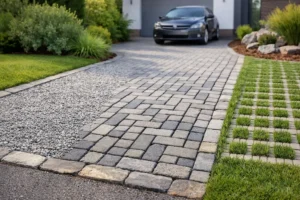
One of the most effective ways to manage water is to let it drain through the surface instead of forcing it all across the top. Permeable systems are designed to allow rainwater to pass through and filter into the base below, where it can drain away gradually.
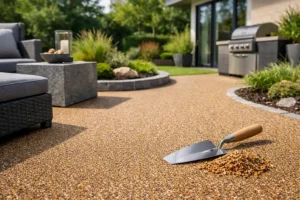
This approach reduces surface water, cuts down on puddling and helps keep the driveway cleaner and safer underfoot. It also avoids the hard, runoff-heavy behaviour you often get from older impermeable surfaces. Resin bound surfacing is a strong example of this. When installed correctly over a suitable base, it offers a decorative finish with built-in permeability, making it a practical choice for properties that want both performance and kerb appeal.
That said, permeability is only as good as the build-up underneath. If the base is not designed to accept and move water properly, the surface will not perform as intended. This is why specialist installation matters.
Channel drains
Channel drains are commonly used where water needs to be intercepted and redirected before it reaches a building, garage threshold or public footpath. They sit flush with the surface and collect runoff through a grated top, carrying it away to a suitable outlet.
They are particularly useful on sloping driveways or where a surface is intentionally graded towards a collection point. A well-positioned channel drain can solve a specific water issue very effectively, but it should not be used to compensate for poor overall design. If the falls are wrong, the drain may end up overloaded or leave water stranded elsewhere.
Visual finish matters here too. On a high-quality driveway, the drainage should feel integrated rather than bolted on as an afterthought.
Soakaways and underground drainage
Where water cannot simply run into adjacent ground, a soakaway or underground drainage system may be needed. This gives collected water a controlled route away from the driveway and into a suitable drainage point.
This type of solution is often necessary on larger driveways, heavily sloped sites or properties with limited natural drainage. It is effective, but it does involve more groundwork and the suitability of the ground conditions has to be considered. Heavy clay soils, for example, may drain more slowly than free-draining ground.
Regrading and correcting falls
Sometimes the smartest fix is not adding more drainage products but correcting the shape of the driveway itself. If the slope is wrong, water will always find the low spots. Regrading creates the right falls so that water moves naturally towards a drainage point or through a permeable structure.
This can be the difference between a driveway that constantly needs patch fixes and one that simply works. It is not the most visible upgrade, but it is often the most valuable.
Choosing a surface that helps, not harms
Surface choice has a major effect on drainage performance. Traditional impermeable finishes can move water quickly across the top, which may sound fine until that water reaches a weak edge, a garage, a doorway or the pavement outside.
By contrast, permeable finishes ease the pressure by allowing rainfall to pass through the surface structure. For many domestic properties, that is a cleaner and more efficient answer. It also supports the wider goal most customers have in mind – a driveway that looks better, lasts longer and needs less day-to-day upkeep.
This is one reason resin bound systems continue to stand out. They combine a modern decorative finish with practical drainage benefits, provided the specification is right. For clients who want a surface upgrade rather than another short-term repair, that balance of appearance and performance is hard to ignore.
What to consider before choosing driveway drainage solutions
The right specification depends on more than the amount of rain a driveway sees. The slope of the site, the existing base, nearby buildings and the intended finish all influence the answer.
A flat driveway might benefit most from a permeable surface and carefully prepared sub-base. A steep driveway may need a combination of corrected falls and channel drainage. A property near a garage or entrance door may require more controlled water collection to stop runoff reaching the threshold.
There is also the question of maintenance. Some systems need regular clearing to keep them working properly. Channel drains can trap leaves and debris. Permeable surfaces may need occasional cleaning to stop dirt build-up affecting drainage performance. The best option is not just the one that works in theory, but the one that suits how the property will actually be used.
Common mistakes that lead to expensive problems
One of the biggest mistakes is treating drainage as an add-on. By the time puddles appear, the problem is usually rooted in the structure below. Another is choosing the cheapest installation route without asking how water will be managed over the long term.
There is also a tendency to assume that all resin surfaces are permeable. That is not the case. Resin bound and resin bonded are different systems with different performance characteristics, so the drainage benefits depend on the product and installation method used.
Poor edge restraint, rushed groundwork and inadequate base preparation can all undermine an otherwise attractive driveway. A surface may still look smart for a while, but water has a way of exposing weak work quickly.
Why specialist installation makes the difference
Drainage is not only an engineering concern. It affects appearance, durability and value. A driveway that stays cleaner, drains properly and avoids standing water will generally keep its finish for longer and make a stronger first impression.
That is why specialist surfacing contractors approach the job as a complete system rather than a top layer. The base, falls, drainage route and finished material all need to work together. For homeowners in Belfast and across Northern Ireland, that local experience matters too. Weather patterns, ground conditions and site constraints can vary, and practical knowledge often prevents the kind of shortcuts that cause repeat issues later.
Surface King works with clients who want more than a cosmetic improvement. They want a driveway that performs properly, complements the property and holds up under daily use. That means looking beyond the visible finish and getting the groundwork and drainage right from the start.
Driveway drainage solutions that protect your investment
The most effective driveway drainage solutions are the ones planned early, built properly and matched to the property. Sometimes that means a permeable resin bound surface over a suitable sub-base. Sometimes it means combining surface choice with channels, soakaways or level corrections. The right answer depends on the site, not on whichever product happens to be most familiar.
If your driveway already holds water, stains easily or shows signs of early wear, the surface may be telling you that the drainage strategy needs attention. Fixing that does more than stop puddles. It protects the structure, improves safety and gives your driveway the finish it should have had all along.
A well-built driveway should not leave you working around the weather. It should deal with it quietly, keep its shape, and keep looking the part year after year.