A warehouse floor can look perfectly acceptable on handover, then fail quickly once pallet lorries, cleaning chemicals, dropped tools and daily footfall begin to test it. This commercial epoxy flooring buyers guide is designed to help facilities managers, business owners and project teams specify a floor for real working conditions, not just a good first impression.
Epoxy remains one of the most trusted commercial resin flooring options because it creates a hard-wearing, easy-to-clean and professional finish. But “epoxy flooring” is not one standard product. The right system depends on your substrate, environment, operational demands, safety requirements and available shutdown period.
Commercial epoxy flooring buyers guide: start with the job
The best buying decision starts with what happens on the floor every day. A retail back room, commercial kitchen, healthcare corridor and manufacturing workshop may all need durable resin flooring, but they do not place the same demands on the surface.
Think beyond general statements such as “heavy traffic”. Identify what actually moves across the area, how often it is cleaned, whether water or oils are present, and whether machinery generates vibration, heat or impact. A floor used by pedestrians and stock trolleys can suit a different epoxy build-up from one carrying forklift traffic or regularly exposed to solvents.
Your specification should also account for appearance. Epoxy can provide a clean, uniform finish in a wide choice of colours, with demarcation lines, safety zones and branded details where required. For customer-facing spaces, this visual consistency can reinforce the standard of the entire premises. In operational areas, clear line marking can help organise traffic and improve safety.
Understand the main epoxy system options
Epoxy systems are usually selected by thickness, texture and intended level of protection. A specialist contractor should recommend the build-up after assessing the site rather than offering one coating for every environment.
Epoxy floor coatings
A thinner epoxy coating is often suitable for light to medium commercial traffic where the concrete is sound, dry and well prepared. It gives old concrete a cleaner, brighter, less dusty finish and is popular in stock rooms, plant rooms, showrooms and workshops.
The trade-off is that thinner coatings are less forgiving of poor substrate condition and severe impact. If the concrete is cracked, contaminated or exposed to constant forklift use, a basic coating may not offer the service life you expect.
High-build and self-levelling epoxy
High-build epoxy creates a thicker protective layer, while self-levelling systems are designed to produce a smooth, even finish over properly prepared concrete. These are strong choices for commercial interiors that need a hygienic, easy-to-clean surface with a more refined appearance.
They work particularly well in food preparation support areas, healthcare settings, retail spaces and laboratories, provided the system is matched to the required slip resistance and chemical exposure. A smooth floor is easier to clean, but it may not be appropriate where water, grease or spillages are routine.
Epoxy resin mortar and heavy-duty systems
For industrial spaces facing serious impact, abrasion or point loading, epoxy mortar systems offer greater thickness and repair capability. They can be used to reinstate damaged concrete and build a more substantial working surface in factories, loading areas and engineering environments.
These systems cost more than a straightforward coating, but they can be the more economical decision when the alternative is repeated patch repairs and disruptive closures. The correct choice depends on the condition of the slab and the cost of downtime, not simply the initial price per square metre.
Check the concrete before choosing a finish
Epoxy performs only as well as the surface beneath it. Concrete that is weak, damp, dusty, contaminated or poorly repaired can prevent proper adhesion and lead to blistering, delamination or early wear.
Professional preparation commonly involves mechanical grinding, shot blasting or diamond preparation to create a clean, sound profile. Oil contamination may need specialist treatment, while cracks and joints should be assessed before coating. Not every crack can be covered and forgotten. Some movement joints must remain functional, otherwise movement in the building can transfer through the new resin finish.
Moisture is another key consideration. A moisture test helps determine whether the slab is suitable for epoxy as specified or whether a moisture-tolerant primer or alternative system is needed. This is particularly relevant in older premises, ground-floor units and sites where there is no reliable damp-proof membrane.
A good contractor will treat substrate assessment as part of the project, not an optional extra. It protects the investment and avoids a visually impressive floor becoming a costly problem months later.
Specify slip resistance where it is needed
Slip resistance is not a one-size-fits-all decision. A heavily textured floor can improve grip in wet or spill-prone zones, but excessive texture can make cleaning more difficult and may be uncomfortable for wheeled equipment. Conversely, a very smooth finish may look sharp in a showroom but be unsuitable near entrances, wash-down areas or food service operations.
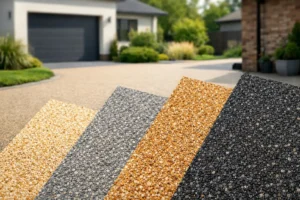
The right approach is to assess the risks by zone. Reception areas, corridors, production lines, loading bays and wash areas may need different finishes within the same building. Aggregate can be incorporated into epoxy to create a more textured surface, while safety markings and contrasting colours can define routes, hazards and work areas.
Ask how the selected texture will perform after regular cleaning, not just on the day it is installed. The cleaning regime, footwear, contaminants and drainage all influence practical slip performance.
Plan for chemicals, heat and UV exposure
Epoxy offers excellent resistance to many common industrial chemicals, oils and cleaning products, but no resin should be specified on a vague assumption that it is chemical-proof. Provide a list of substances used on site, including cleaning agents, fuels, acids, alkalis and process liquids. Concentration, temperature and contact time all matter.
Temperature also affects the decision. Standard epoxy can be an excellent indoor system, but it is not always the best answer for areas with rapid temperature changes, very cold conditions or a requirement for exceptionally fast return to service. MMA and polyaspartic resin systems may be better suited where installation time is tight or cold-weather curing is a concern.
For external or sunlit areas, remember that epoxy can yellow or chalk under ultraviolet exposure. If appearance must remain consistent near large windows, loading doors or outside thresholds, a UV-stable topcoat or a different resin technology may be the stronger choice.
Ask the right questions about installation and downtime
A commercial floor project has to fit around operations. Before appointing an installer, establish when the area can be cleared, what access is available, whether other trades are working nearby and when the floor must return to service.
Curing time is not the same as full operational readiness. A floor may be ready for foot traffic before it is suitable for pallet lorries, racking installation or heavy machinery. Confirm the programme for preparation, priming, resin application, curing and handover, then build in a sensible contingency for substrate repairs.
It is also worth asking about odour, ventilation and site segregation. Professional resin installation is manageable in occupied commercial buildings, but it requires clear planning. Protecting adjacent areas, controlling dust during preparation and keeping staff away from active work zones are basic parts of a reliable installation.
Compare quotations on scope, not just price
The lowest quotation can become the most expensive if it excludes essential preparation, crack repairs, moisture management or the correct number of coats. Compare the full system being offered, including the proposed thickness, preparation method, primer, body coat, topcoat, slip-resistant finish, repairs and line marking.
You should also confirm whether the quoted price includes moving equipment, edge detailing, waste removal and access restrictions. These are common areas where commercial projects can change in cost if they have not been discussed early.
At Surface King, the focus is on recommending a resin system that performs for the setting, while delivering the clean, high-quality finish your premises deserve. A site assessment gives the project team the information needed to advise with confidence rather than relying on assumptions.
Choose a floor that supports the way you work
A commercial epoxy floor should make the premises easier to run: cleaner walkways, clearer operational zones, simpler maintenance and a surface capable of handling daily pressure. The best result is rarely the thickest or most expensive system. It is the one properly prepared, correctly specified and installed around the demands of your site.
If you are planning an upgrade, begin with a clear conversation about the condition of your concrete, the traffic it carries and the finish you want visitors and staff to see. That is where a long-lasting floor starts.