If your floor cannot sit out of action for days, the choice between mma flooring vs epoxy becomes a business decision, not just a product comparison. In busy retail units, food settings, workshops and healthcare environments, the wrong resin system can cost more in downtime, disruption and future repairs than it saves on day one.
Both systems have a strong place in commercial flooring. Both can deliver a clean, hard-wearing, easy-to-maintain finish. But they do not behave the same way during installation, and they do not suit the same sites, budgets or timelines. That is where a specialist approach matters.
MMA flooring vs epoxy: the main difference
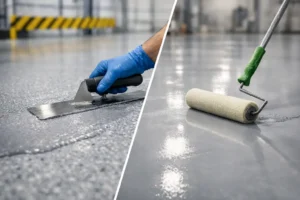
The biggest difference between MMA and epoxy is cure time. MMA, short for methyl methacrylate, is designed for speed. It can often cure within a matter of hours, even in colder conditions, which makes it a strong option for sites that need to reopen quickly. Epoxy takes much longer to cure, often over a number of days depending on the system, site temperature and specification.
That single difference affects almost everything else. It influences programme planning, labour scheduling, access restrictions and how practical the installation is in a live environment. If a client needs a floor installed overnight, over a weekend or during a short shutdown period, MMA is often the front-runner straight away.
Epoxy, on the other hand, remains a popular choice where there is more flexibility in the programme and where clients want a cost-effective, durable finish for medium to heavy use. It is widely specified because it performs well, looks smart and offers good long-term value when the site conditions are right.
Where MMA flooring performs best
MMA flooring is built for environments where time matters. In commercial settings, that can be the difference between staying operational and losing trading hours. Hospitality venues, food production areas, pharmacies, retail units and certain healthcare spaces often benefit from MMA because access can be restored far more quickly than with traditional resin systems.
It also performs well in lower temperatures. That is a major advantage in unheated buildings, external covered areas or winter installation periods, where other systems may struggle to cure properly or may face delays. In Northern Ireland, that matters more than many people first expect.
From a performance point of view, MMA is hard-wearing, slip-resistant when specified correctly, and available in a range of finishes and colours. It is not just a fast option. It is a serious industrial flooring system in its own right.
The trade-off is cost and installation sensitivity. MMA is usually more expensive than epoxy, and it needs experienced handling. The material has a strong odour during application, so ventilation and site management need proper attention. It is not a product to cut corners with.
Where epoxy still makes strong sense
Epoxy remains one of the most widely used resin flooring systems for good reason. It delivers an attractive, practical and durable surface that suits warehouses, plant rooms, workshops, garages, showrooms and many back-of-house commercial areas.
If the site can allow longer curing times, epoxy often gives clients an excellent balance of price and performance. It bonds well to prepared concrete, creates a smooth professional finish and can be tailored for hygiene, chemical resistance or decorative impact depending on the specification.
For some projects, epoxy is simply the smarter commercial choice. If a floor is being installed as part of a wider fit-out programme and there is no urgent reopening deadline, paying more for MMA may not bring enough benefit to justify the extra spend.
That said, epoxy is less forgiving when temperatures drop and the environment is damp or inconsistent. Cure times can stretch, project timelines can slip, and using the area too early can damage the finish before it has fully hardened.
Durability: which one lasts longer?
This is where clients often expect a clear winner, but the honest answer is that it depends on the environment and the quality of installation. Both MMA and epoxy can deliver long-lasting results when the substrate is prepared properly and the right system is chosen for the demands of the space.
Epoxy is known for its strong mechanical resistance and solid all-round performance. In many commercial and light industrial settings, it provides years of service with minimal fuss. MMA also offers excellent durability, particularly where thermal movement, regular cleaning or rapid return to service are part of the brief.
A floor does not fail just because of the resin type. More often, it fails because of moisture issues, poor surface preparation, incorrect product selection or rushed installation. That is why choosing between mma flooring vs epoxy should never be based on a brochure alone.
Appearance and finish options
From a design point of view, both systems can produce a clean, high-quality result. Epoxy is well known for its glossy, professional appearance and is often chosen for spaces where presentation matters as much as practicality. Showrooms, commercial units and customer-facing environments regularly favour epoxy for that reason.
MMA can also achieve excellent visual results, including decorative and textured finishes, line markings and slip-resistant surfaces. It is more than a functional industrial coating. For clients who want strong performance without compromising on presentation, it can tick both boxes.
The right finish comes down to how the space is used. A smooth, high-gloss look may suit one site perfectly but create maintenance or slip concerns in another. Good flooring design is not just about colour charts. It is about matching appearance with real-world use.
Installation, downtime and disruption
For many businesses, this is the section that matters most. A cheaper floor is not cheaper if it keeps the premises closed for too long.
MMA is the clear leader for fast turnaround. In the right conditions, areas can often be handed back within hours rather than days. That makes it ideal for phased works, overnight programmes and operations that cannot afford extended closures.
Epoxy needs more patience. It can still be the right system, but the installation programme has to reflect the curing period properly. If heavy traffic, stock movement or equipment returns to the area too early, the floor can suffer before it has had a fair start.
This is where a specialist contractor adds real value. It is not just about laying resin. It is about planning the job around your business, access needs and operational pressures.
Cost versus value
MMA usually comes with a higher upfront cost. The materials are more expensive, and the installation process demands experienced teams who can work accurately within tight cure windows. On paper, epoxy often looks more budget-friendly.
But value is not the same as purchase price. If an MMA floor saves a business several days of lost trading, avoids a long shutdown or allows work to be completed in colder weather without delay, the numbers can shift quickly in its favour.
Epoxy delivers strong value where programme time is less critical and the environment suits the product well. It remains a reliable investment for many commercial and industrial floors. The key is to judge cost against the full picture, not just the quote total.
How to choose between mma flooring vs epoxy
Start with the practical questions. How quickly does the area need to reopen? What temperatures will the installation face? How heavy is the traffic? Does the floor need chemical resistance, slip resistance or a more decorative finish? Is the space customer-facing, back-of-house or fully industrial?
If speed, cold-weather curing and minimal downtime are top priorities, MMA is often the stronger option. If budget control, appearance and proven all-round durability matter more than rapid return to service, epoxy may be the better fit.
The best results come from specifying the floor around the site, not trying to make the site fit the floor. That is exactly why many clients choose a specialist contractor and supplier rather than relying on a general builder or a one-size-fits-all recommendation.
At Surface King, that means looking at the substrate, the programme, the finish and the long-term use before recommending any system. A floor should do more than cover concrete. It should improve the way the space performs and the way it looks from day one.
If you are weighing up MMA against epoxy, the right answer is usually the one that protects your time as well as your floor. A well-specified resin system pays for itself in appearance, durability and fewer headaches later on. The smart move is to choose the option that suits how your space actually works.