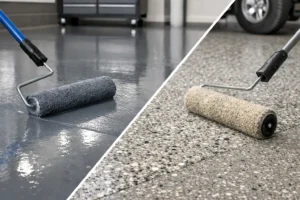
A floor usually starts getting attention when it has already failed – dusting in a warehouse aisle, tyre marks baked into a loading bay, or cracked paint at the entrance of a customer-facing unit. That is exactly why a commercial floor coating specification guide matters. The right specification does far more than choose a product. It sets the standard for durability, safety, appearance, cleaning, downtime and long-term value.
For commercial premises, guessing is expensive. A coating that looks fine on paper can break down quickly if the substrate is damp, forklift traffic is heavier than expected, or cleaning chemicals are more aggressive than the original brief suggested. Good specification work gets ahead of those problems. It matches the resin system to the real site conditions, not just the budget line.
What a commercial floor coating specification guide should cover
A proper commercial floor coating specification guide should answer five practical questions. What is happening on the floor every day? What is underneath the coating? How quickly does the area need to return to service? What finish is required visually and functionally? And how long does the client expect the system to last before major refurbishment?
Those points sound straightforward, but they change everything. A retail stockroom and a food prep area may both need a hard-wearing floor, yet they will not need the same build-up, texture or chemical resistance. The same goes for a showroom compared with a production facility. One prioritises visual finish and brand presentation. The other may need impact resistance, anti-slip performance and tolerance for washdowns.
That is why specification should never begin with, “We usually use epoxy.” Epoxy may be the right answer, but so might polyurethane, MMA or polyaspartic systems depending on the environment and programme.
Start with the site, not the product
The strongest specifications begin with a survey. This is where many projects are won or lost. The substrate condition, moisture content, existing coatings, cracks, contamination and levels all need to be understood before any material is chosen.
Concrete is the most common base in commercial settings, but not all concrete performs the same way. New slabs can retain moisture. Older slabs may be weak at the surface or contaminated by oil, grease or previous treatments. If the floor has laitance, movement cracks or poor falls, a high-performance coating alone will not solve the underlying issue.
Usage also needs to be defined with some honesty. Light foot traffic, pallet trucks, forklifts, wheeled cages and point loading create very different wear patterns. So do thermal shock, regular washdowns and spillages from oils, acids or cleaning agents. If the area is public-facing, appearance will matter more. If it is operational, downtime may be the deciding factor.
Choosing the right resin system
Epoxy coatings
Epoxy remains a popular choice for many commercial floors because it gives a strong, attractive and easy-to-clean finish. It works well in warehouses, plant rooms, retail back-of-house areas and many general commercial spaces. It can be built as a thin coating, a heavier-duty screed or a self-smoothing system depending on the demands of the site.
The trade-off is curing time and UV stability. Epoxy can take longer to return to service than faster-curing systems, and some formulations may amber in sunlight. For internal areas with controlled conditions, that may not matter. For spaces with tight handover programmes, it often does.
Polyurethane systems
Polyurethane flooring systems are often specified where thermal resistance, flexibility and chemical performance are more demanding. They are a strong option for food and drink production, commercial kitchens and heavy industrial settings. They cope well with harsher service conditions and can outlast lighter-duty systems where cleaning regimes are aggressive.
They are not always the cheapest route at the outset, but in the right setting they can be the most cost-effective over time. A lower initial price means little if the floor needs patching or replacement far earlier than expected.
MMA and polyaspartic systems
Where speed matters, MMA and polyaspartic technologies come into their own. These systems are valuable for sites that cannot tolerate lengthy closures, such as hospitality venues, healthcare areas, retail units or operational industrial spaces.
Fast-curing does not mean one-size-fits-all. These systems still need careful preparation and correct detailing. Used properly, they can reduce downtime dramatically. That is a major commercial advantage where every closed hour affects revenue or operations.
Performance requirements that should be written into the specification
A floor coating specification should not stop at naming a product family. It should define performance clearly.
Slip resistance is one of the biggest examples. Many clients ask for an anti-slip floor without defining the actual environment. A lightly textured finish may suit a dry corridor or retail back room. It may be wholly inadequate for a wet processing area or an entrance subject to rain and footfall. More texture generally improves grip, but it can also make cleaning more demanding. The right balance depends on the space.
Chemical resistance should also be matched to real exposure, not a vague assumption. Occasional contact with mild detergents is one thing. Repeated spills from solvents, oils, acids or food by-products are another. The same principle applies to impact and abrasion. If metal stillages, dropped tools or constant vehicle traffic are part of daily life, the system build-up needs to reflect that.
Finish matters too. Gloss, satin and matt finishes all create a different visual effect and maintenance profile. Decorative flake or quartz systems can improve appearance and hide wear in customer-facing environments. Solid-colour resin may be ideal for cleaner, more functional spaces. In some facilities, line marking, zoning and safety colour coding should be included from the start rather than added later as an afterthought.
Surface preparation is not the place to cut corners
If there is one part of a commercial flooring project that should never be watered down, it is preparation. Mechanical preparation, crack repair, local remediation and priming are what allow the coating system to bond properly and perform as specified.
This is where cheap quotes often hide their compromises. A floor may look similar on day one whether it has been prepared correctly or not. The difference shows up later in peeling, blistering, premature wear and patchy finish. For a client, that means disruption, further cost and a floor that never quite inspires confidence.
A serious contractor will want to know whether shot blasting, grinding or scarifying is needed, whether repairs should be carried out before coating, and whether moisture levels are suitable for the chosen system. That is not overcomplication. It is basic quality control.
Matching the specification to the setting
Retail, hospitality and customer-facing spaces
These environments need more than durability. They need a finish that supports the look of the business while standing up to regular cleaning and public use. Decorative resin systems, clear zoning and a clean, professional appearance often carry as much weight as technical performance.
Fast turnaround can be crucial here. If a venue needs to reopen quickly, specification should reflect that from day one rather than forcing a compromise once the programme becomes tight.
Industrial and manufacturing sites
Here, specification is usually driven by traffic, impact, contamination and downtime. Thickness, build-up and resistance become more critical, and the wrong choice shows up quickly under hard use.
For these sites, a practical, honest brief is essential. If forklifts operate daily, say so. If oils, chemicals or hot washdowns are routine, that needs to be built into the system selection.
Healthcare, education and public buildings
These settings often need a balance of hygiene, safety, appearance and programme control. Easy cleaning, low odour installation planning and dependable slip performance may all be priorities. In sensitive environments, access phasing and minimal disruption can be just as important as the final finish.
Budget, lifespan and whole-life value
A lower-cost system can be perfectly suitable in the right space. Not every commercial floor needs a heavy-duty industrial screed. But the specification should be honest about expected lifespan, maintenance needs and limitations.
The cheapest option usually becomes expensive when it is installed in the wrong setting. A better approach is to align spend with use. If the floor is a heavy-use operational asset, it should be treated that way. If it is a lighter-duty commercial area, a simpler system may be entirely appropriate.
That is where specialist advice adds value. A good specification protects the client from overspending on unnecessary performance, but it also prevents underspecifying a floor that will be tested from the first week.
A better brief leads to a better floor
The best commercial floor coating specification guide is not really about products. It is about making sure the finished floor works for the business using it. That means understanding the site, choosing the right resin technology, setting clear performance requirements and refusing to compromise on preparation.
For clients across Belfast and Northern Ireland, that often means working with a specialist who can advise, supply and install with the full picture in mind. When the specification is right, the result is simple – a floor that looks sharper, lasts longer and performs properly under pressure.
If you are planning a new commercial floor, start with the questions the space cannot afford to get wrong.