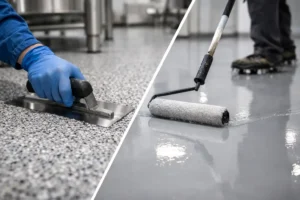
A floor can look impressive on handover day and still be the wrong choice six months later. That is usually where the real question starts with resin flooring or polished concrete – not which one looks smarter in a brochure, but which one will keep performing under your traffic, cleaning routine and day-to-day use.
For homeowners upgrading garages, courtyards and utility spaces, and for commercial sites managing hygiene, safety and downtime, this decision matters. Both finishes can deliver a clean, modern result. Both can outperform tired tiles, worn concrete and patchy coatings. But they do very different jobs once the space is in use.
Resin flooring or polished concrete – what is the real difference?
Polished concrete is the existing or newly poured concrete slab, mechanically ground and polished to create a harder, more refined surface. Its appeal is obvious. It has an industrial, architectural look, works well in open-plan spaces and can feel understated in the right setting.
Resin flooring is a surface system applied over a prepared substrate. Depending on the environment, that could mean epoxy, polyurethane, MMA or polyaspartic resin. The result is a high-performance floor designed around the demands of the space. That is the key distinction. Polished concrete enhances the slab you already have. Resin flooring lets you engineer the finish, texture, durability and chemical resistance you actually need.
That difference becomes more important as soon as appearance stops being the only factor.
Where polished concrete works well
Polished concrete suits spaces where the slab quality is already high and the visual goal is minimal, modern and raw. In some homes, showrooms and design-led interiors, that can be exactly the right fit. It reflects light well, helps create a spacious feel and avoids the layered look of some applied systems.
If you have a good structural slab and you like the natural variation of concrete, polishing can produce a smart result. Many clients also like the fact that it uses the base material itself rather than covering it entirely.
The trade-off is that concrete still behaves like concrete. It can stain, it can crack, and it relies heavily on the quality of the slab underneath. Hairline cracks may add character in one setting and look like a defect in another. In a domestic interior, that may be acceptable. In a commercial environment where consistency, hygiene or brand presentation matter, it is often less appealing.
Polished concrete can also become less forgiving in areas exposed to oils, chemicals, standing water or heavy impact. It is not automatically the lower-maintenance choice people sometimes expect.
Why resin flooring is often the stronger performer
Resin flooring is built for control. Instead of working around the limitations of the slab, the system is selected to match the conditions. That gives property owners and facilities teams more certainty from the start.
In practical terms, resin can provide a seamless, easy-to-clean surface with strong resistance to wear, spills and frequent footfall. It can be specified with anti-slip texture, decorative finishes, line marking, zoning colours or hygienic coved details. In commercial and industrial settings, that flexibility is a major advantage. In domestic settings, it means the floor can look sharp while standing up to real use.
This is particularly relevant in garages, workshops, retail units, salons, hospitality spaces, healthcare environments and back-of-house areas. These are not surfaces that need to look good only when freshly installed. They need to cope with dragging equipment, regular mopping, occasional knocks and the general mess that comes with busy properties.
For many clients, the visual side matters just as much. Resin flooring does not mean settling for a flat, purely functional finish. Modern systems can be sleek, decorative and highly tailored, with a wide choice of colours and performance specifications.
Cost is never just the installation price
The budget conversation around resin flooring or polished concrete can be misleading if it focuses only on the initial figure. A polished concrete floor may appear simpler on paper, especially if there is already a slab in place. But that assumes the slab is suitable, level enough, free from significant defects and capable of polishing to a standard worth paying for.
If the slab needs repairs, densification, extensive grinding or remedial work, the price can quickly move. And even after installation, cleaning products, stain management and ongoing surface care all affect long-term cost.
Resin flooring can involve more system selection upfront, but that is often where the value sits. You are investing in a floor built around the environment rather than adapting expectations to the slab. In many commercial spaces, that means fewer interruptions, easier cleaning and less risk of premature failure.
The right question is not which option is cheapest on day one. It is which option gives you the best return over the years you plan to use the space.
Maintenance and day-to-day use
This is where surface choice becomes very real very quickly.
Polished concrete is often marketed as easy to live with, but it still needs proper care. It can mark, dull in high-traffic lanes and absorb certain spills if they are not dealt with promptly. Depending on the environment, periodic maintenance may be needed to keep the finish looking its best.
Resin flooring is typically easier to manage in demanding settings because the surface is non-porous and designed for straightforward cleaning. Dust control is better, spills are easier to deal with and there are no grout lines trapping dirt. For commercial operators, that can save time every single day. For homeowners, it means less frustration and a cleaner-looking space with less effort.
Of course, not all resin systems are equal. A heavy-duty warehouse floor has different requirements from a garage conversion or a retail unit. That is why specialist advice matters. The right resin specification is what turns a good-looking floor into a reliable one.
Design matters, but so does consistency
Polished concrete has a distinct aesthetic. If you want natural tonal variation, visible aggregate and an industrial edge, it can be very effective. But it is harder to control. The final appearance depends on the slab, the mix, the curing and the polishing process. Two areas in the same property may not finish exactly the same.
Resin flooring offers a more controlled visual result. You can achieve clean block colours, decorative flakes, high-gloss or matt finishes, and practical details such as demarcation zones or safety markings. For businesses, that consistency supports presentation and brand standards. For domestic clients, it gives more confidence that the finished surface will look the way it was intended to look.
That control is one reason resin continues to gain ground in both commercial and high-spec residential projects. It combines visual impact with practical performance rather than forcing a compromise between the two.
Which is better for homes and which is better for business?
It depends on the setting, but resin flooring is usually the more versatile choice across a wider range of applications.
In homes, polished concrete can work well in design-led interiors where the slab is suitable and the owner accepts the natural movement and variation that come with concrete. Resin is often the better option for garages, utility areas, basements and spaces where easy cleaning, durability and a sharper decorative finish are priorities.
In commercial and industrial environments, resin flooring is often the stronger investment. It is better suited to hygiene requirements, anti-slip performance, chemical exposure, safety zoning and quick installation programmes where downtime needs to be kept to a minimum. That is why specialist contractors and suppliers tend to recommend resin systems for working environments that need more than appearance alone.
For property owners in Belfast and across Northern Ireland, the best outcome usually comes from assessing how the floor will actually be used, not just how it will look on completion. Surface King works with clients on exactly that basis – matching the system to the space so the finish delivers on performance as well as appearance.
Making the right choice on resin flooring or polished concrete
If you are choosing between resin flooring or polished concrete, start with function before finish. Ask what the space has to cope with. Daily footfall, vehicles, moisture, cleaning chemicals, food service, equipment movement and presentation standards all shape the right answer.
If the brief is architectural simplicity and the slab is excellent, polished concrete may be the right fit. If the brief is durability, lower maintenance, design flexibility and reliable performance, resin flooring is often the stronger option.
The best surface is the one that still looks right and performs properly long after the installation team has left. Choose with that in mind, and you are far more likely to end up with a floor that earns its place every day.