A sloped driveway looks smart from the road until the weather turns. Then every weakness shows up at once – standing water at the bottom, loose stone travelling downhill, tyres scrubbing the surface, and a finish that becomes harder to keep safe and tidy year after year. That is why choosing the best surfaces for sloped driveways is less about fashion and more about performance. The right surface needs to grip, drain, carry vehicle weight and still improve the appearance of the property.
For most homes, the best choice comes down to how steep the drive is, how much water it needs to handle, what sits underneath it, and how much maintenance you are willing to take on. There is no single answer for every site, but there are clear winners and clear mistakes.
What the best surfaces for sloped driveways need to do
A flat driveway can hide problems for years. A sloped one cannot. Water gathers pace, braking pressure increases, and any weak point in the finish tends to fail faster.
That means the surface has to do four jobs well. First, it needs traction, especially in wet or frosty conditions. Second, it must manage water properly so runoff does not wash over the surface or pool at the bottom. Third, it needs structural stability, because drives on an incline take repeated stress from vehicles moving up, down and turning. Finally, it should still deliver kerb appeal. A driveway is one of the first things people notice, and on many properties it covers a large, highly visible area.
If one of those areas is ignored, the result is usually expensive. A driveway that looks impressive but becomes slippery is a poor investment. Equally, a purely functional finish can drag down the whole frontage of a well-kept home.
Resin bound surfacing
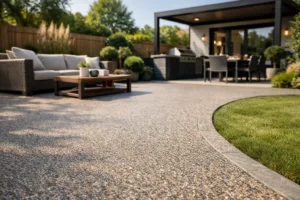
When clients ask us which surface offers the strongest balance of appearance and performance, resin bound is usually at the top of the conversation. It creates a smooth, stone-rich finish that looks high-end, but its value on a slope is not just visual.
A properly installed resin bound driveway is permeable, which means water drains through the surface rather than racing across it. That is a major advantage on sloped sites, where runoff can otherwise become a constant issue. It also avoids the loose movement you get with gravel, so the finish stays clean, uniform and easier to maintain.
Grip matters as well. Resin bound systems can be specified with aggregates that support good slip resistance, making them a practical option for driveways that need to remain safer in wet weather. They also offer strong design flexibility, with a wide choice of stone blends, borders and layout details that can transform the front of a property rather than simply covering it.
The key point is installation quality. Resin bound is only as good as the base beneath it and the preparation behind it. On a sloped driveway, that matters even more. If the base is unsound or drainage has not been considered properly, the finished surface will not perform as it should. Done correctly, though, resin bound is one of the strongest all-round answers for homeowners who want durability without sacrificing style.
Tarmac on a slope
Tarmac remains a reliable option for sloped driveways, especially where practicality and strength are the main priorities. It copes well with vehicle traffic, gives a neat uniform finish and can be laid efficiently over the right base.
On steeper drives, tarmac’s main strength is its solid, continuous surface. Unlike loose materials, it stays put. It is also familiar, cost-effective and well suited to larger areas where budget has to be considered alongside performance.
Its limitation is drainage. Standard tarmac is not permeable, so water management has to be built into the driveway design through falls, channels or other drainage measures. It is also less decorative than resin bound and can soften visually over time if the property needs a more premium finish. For some homes that is perfectly acceptable. For others, it can feel functional rather than transformative.
Block paving
Block paving can work on sloped driveways, but it needs careful planning. Many homeowners like it because it offers pattern, colour contrast and a traditional look that suits a wide range of properties.
The challenge is movement. On a slope, individual blocks are under more pressure from braking and turning vehicles, and if the installation is not first-rate, rutting or spreading can develop. Weed growth in joints and ongoing maintenance can also become more noticeable over time.
This does not mean block paving is a poor option. It means it is more dependent on edge restraint, sub-base quality and long-term upkeep than some people expect. If appearance is the priority and the incline is moderate rather than severe, it can still be a strong choice. If the slope is significant, there are often more stable, lower-maintenance alternatives.
Concrete
Concrete has obvious strengths. It is hard-wearing, durable and capable of handling heavy use. On a sloped driveway, it provides a stable surface that does not shift under traffic.
However, plain concrete can be unforgiving in both appearance and performance. If finished too smoothly, it can become slippery. If it cracks, repairs are often visible. Decorative concrete options exist, but they do not always deliver the same refined finish that homeowners want at the front of the property.
It is usually better suited to sites where utility comes first, or where the design has been handled carefully to improve grip and appearance. For many residential projects, clients want something that feels more considered and adds more visual value.
Gravel and loose stone
Gravel is rarely one of the best surfaces for sloped driveways, even though it can look attractive at first and costs less upfront. The problem is simple: gravity wins.
Loose stone tends to migrate downhill, creating thin patches, uneven coverage and mess at the bottom of the drive or on the pavement. Vehicle tyres can displace it further, and walking across it on an incline is less comfortable than on a stable bound surface.
There are grid systems designed to improve gravel retention, and on mild slopes they can help. But once the incline becomes more demanding, gravel usually creates more maintenance than most homeowners want. What begins as a budget-friendly option often turns into a recurring job of raking, topping up and tidying.
How slope, drainage and base preparation change the answer
Two driveways can look similar from the road and need completely different solutions. A short gentle incline is one thing. A long steep approach with heavy rainfall exposure is another.
That is why surface choice should never be made from samples alone. The underlying base, the direction of water flow, the turning area for vehicles and the condition of the existing driveway all affect what will work best. In many cases, the surface itself is only part of the job. If the base has failed, or if water has nowhere to go, no premium finish will compensate for it.
This is where specialist advice makes a real difference. A good result starts with understanding the site, not pushing a standard product onto every property.
Which surface is best for most homeowners?
If you want the strongest blend of drainage, low maintenance, durability and visual impact, resin bound is hard to beat. It answers the practical problems that sloped driveways create while giving the property a cleaner, more tailored finish.
If budget is tighter and the site is structurally straightforward, tarmac remains a dependable option. If you prefer a more traditional style and accept some ongoing maintenance, block paving may suit. Concrete has its place where strength is the main concern. Gravel is usually best avoided on anything beyond a mild incline.
For homeowners across Belfast and Northern Ireland looking to upgrade a sloped driveway properly, the aim should be simple: choose a surface that performs in bad weather, wears well under daily use and lifts the whole frontage of the property. That is exactly why specialist resin systems continue to gain ground over older, more limited finishes.
A driveway on a slope asks more from every material. Choose well, and it stops being a problem area and starts becoming one of the strongest features of your home. If you are planning a new driveway and want expert guidance on the right finish for your site, Surface King can help you assess the slope, base and drainage before a single square metre is laid.