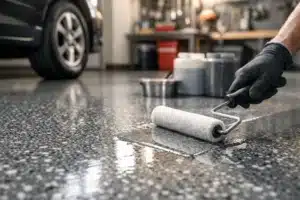
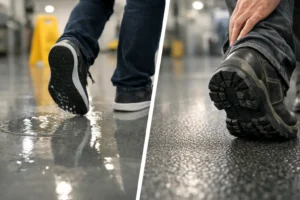
A floor beside a commercial oven, wash-down area or busy production line has a harder job than most. It must cope with hot water, cleaning chemicals, dropped stock, constant footfall and the occasional pallet lorry without becoming difficult to clean or expensive to repair. This polyurethane cement floor review looks at whether this specialist resin system earns its reputation in demanding UK workplaces.
Polyurethane cement, often called PU cement or polyurethane concrete, is not designed to be a fashionable finish for every room. It is a high-performance flooring solution for areas where ordinary concrete, tiles and many standard resin coatings can fail. For the right site, it provides a long-lasting, hygienic and highly practical surface. For the wrong site, it can be more specification than you need.
What is polyurethane cement flooring?
Polyurethane cement is a resin mortar system made from polyurethane resin, cement, aggregates and pigments. Once installed and cured, it creates a dense, hard-wearing floor with a textured or smoother finish depending on the intended use. It is commonly laid at a greater thickness than a decorative coating, which gives it the strength to deal with physical impact and challenging service conditions.
The system is particularly well suited to food and drink production, commercial kitchens, breweries, dairies, pharmaceutical settings, warehouses, workshops, healthcare back-of-house areas and manufacturing facilities. These are environments where hygiene, safety and downtime matter as much as appearance.
Unlike resin bound surfacing, which is primarily used to create attractive permeable external finishes, PU cement is a closed industrial floor system. Its job is to protect the substrate and keep a working environment cleaner, safer and easier to maintain.
Polyurethane cement floor review: where it performs best
The strongest reason to choose polyurethane cement is its ability to cope with extremes that put ordinary floors under pressure. Thermal shock is a key example. Where a floor is regularly exposed to steam, hot liquid, boiling wash-down water or rapid temperature changes, some coatings can soften, crack or lose adhesion. A correctly specified PU cement system has much better resistance to this type of stress.
It also performs well in wet-process environments. Its dense construction helps resist water ingress, while a suitable non-slip aggregate profile can improve safety where spillages are unavoidable. This matters in commercial kitchens, preparation areas and factory spaces, where a floor that looks clean but becomes hazardous when wet is not a good result.
Chemical resistance is another major advantage. Cleaning regimes can involve detergents, sanitisers, fats, oils and mild acids. Polyurethane cement is built to withstand many of these substances far better than unprotected concrete. The exact resistance will depend on the chemical concentration, temperature and exposure time, so the floor specification should always be matched to the actual cleaning and production process.
For busy industrial sites, the material’s mechanical strength is equally valuable. It can stand up to regular trolley, pallet lorry and foot traffic, provided the correct thickness and finish are selected. A light-duty storeroom does not need the same build-up as a heavy-use production area, and treating every floor as identical is where poor specifications begin.
The benefits clients notice after installation
A polyurethane cement floor changes the working experience as well as the look of the space. The finished surface is continuous, rather than divided by tile joints and grout lines. That leaves fewer places for dirt, moisture and bacteria to gather, making regular cleaning more straightforward.
The surface is also designed for longevity. Instead of repeatedly patching dusty concrete or replacing cracked tiles, a professionally installed resin system can provide a reliable working floor for years. This is especially useful for facilities managers trying to reduce disruption and avoid reactive maintenance.
Appearance still has a role. PU cement is available in practical colours that can brighten tired operational spaces, support zoning or help separate pedestrian routes from work areas. It is generally more functional than decorative epoxy or polished concrete, but a clean, uniform floor immediately gives a workplace a more professional standard.
A further advantage is its strong bond to a prepared concrete substrate. In many applications, polyurethane cement can tolerate higher levels of residual moisture than conventional epoxy systems. That can make it a sensible option for certain new slabs and refurbishment projects. It does not remove the need for substrate testing, preparation or moisture management, however. A floor must be assessed properly before any resin is installed.
The trade-offs worth considering
No flooring material is right for every site, and a credible polyurethane cement floor review needs to be clear about the compromises.
First, it is a specialist system and usually costs more than a basic paint coating or low-build epoxy. The initial spend reflects the materials, substrate preparation, skilled installation and the performance expected from the finished floor. In a low-traffic office, showroom or domestic garage, that level of performance may not justify the investment.
Secondly, PU cement is not normally chosen for a high-gloss, highly decorative statement floor. It can look smart, clean and professional, but its priority is industrial resilience. If visual depth, metallic effects, a branded feature area or a completely smooth showroom finish is the main goal, epoxy, polyaspartic or MMA systems may offer a better fit.
Texture needs careful thought too. A more slip-resistant finish is valuable in wet areas, but a heavily textured floor can hold more dirt and require more effort to clean. The best approach is to specify the right slip resistance for the risk, rather than automatically selecting the roughest possible surface.
Finally, colour stability can vary under sustained UV exposure. Polyurethane cement is generally intended for internal or covered operational areas, not sun-exposed decorative spaces. Where appearance under strong daylight is a priority, the system may need a suitable protective topcoat or an alternative finish.
Installation determines the result
Even the best resin material cannot compensate for rushed preparation. The concrete base must be sound, clean and mechanically prepared to create the correct surface profile. Weak laitance, old coatings, oil contamination and loose material need to be removed before the new floor is laid.
Cracks, joints, falls and drainage details all need attention at the survey stage. In wash-down environments, for example, the floor should work with drainage rather than directing water towards doorways or low points. In operational premises, installers must also plan edges, coving, thresholds and movement joints so the finished system performs as one complete surface.
Thickness is another key decision. Thinner systems may suit lighter-duty areas, while heavier-duty floors require a more substantial build-up. This should be based on the expected traffic, impact, temperature exposure and chemical use, not simply on the lowest quotation.
Downtime is often the deciding factor for commercial clients. Some resin systems can be installed in phases or selected for faster return to service, but curing times and site conditions still matter. A good contractor will plan the work around production schedules, access requirements and health and safety controls rather than making unrealistic promises.
Cleaning and maintenance expectations
One of the main attractions of polyurethane cement is that maintenance is straightforward when the floor is cleaned correctly. Routine sweeping removes abrasive grit, while regular washing with compatible products helps maintain hygiene and appearance. The cleaning method should suit the texture of the floor and the contaminants present on site.
Avoid assuming that chemical resistance means total immunity. Highly concentrated chemicals, prolonged pooling and unsuitable cleaning products can damage almost any surface over time. Spillages should be dealt with promptly, and the manufacturer guidance for cleaning agents should be followed.
A periodic inspection is worthwhile, particularly around drains, doorways, expansion joints and areas exposed to frequent vehicle traffic. Small issues are easier and less disruptive to repair before water or contaminants reach the concrete beneath.
Is polyurethane cement the right choice for your premises?
PU cement is an excellent choice where heat, moisture, chemicals, hygiene and hard daily use meet in one place. It is particularly strong for commercial kitchens, food production, processing facilities, breweries and industrial workplaces where a standard coating would be under constant pressure.
For dry retail areas, offices or highly decorative commercial interiors, a different resin system may deliver better value and a more suitable visual finish. The right decision starts with the condition of the concrete, how the space is used, what is likely to spill on the floor and how much downtime the business can accept.
Surface King helps Northern Ireland clients assess those practical details before recommending a system. A properly specified floor should not merely cover old concrete. It should make the space safer to operate, easier to clean and ready for the work it faces every day.