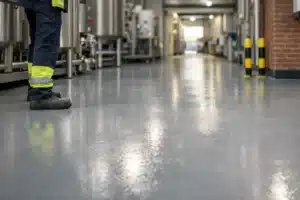
A warehouse floor usually tells the truth before anyone else does. Tyre marks that never quite lift, dust gathering in surface cracks, worn paint around work zones, and patches that stay damp or stained all point to the same problem – the floor is no longer working hard enough for the space. That is where industrial resin flooring in Northern Ireland has become the practical choice for businesses that need a cleaner finish, stronger performance and less disruption over time.
For busy commercial and industrial environments, flooring is not just a finishing touch. It affects safety, cleaning routines, vehicle movement, presentation and downtime. If the wrong system goes in, the cost shows up quickly in repairs, maintenance headaches and operational hold-ups. If the right one goes in, the floor becomes an asset that supports the way the building actually runs.
Why industrial resin flooring in Northern Ireland is in demand
Across Northern Ireland, facilities managers, manufacturers, retailers and site owners are under pressure to get more from their premises. Floors need to cope with forklifts, foot traffic, spillages, cleaning chemicals and temperature changes without looking tired after a short period. Traditional concrete on its own rarely delivers that standard for long.
Resin systems answer that problem by creating a durable, sealed surface that is easier to maintain and better suited to demanding environments. In practical terms, that means less dust, better resistance to wear, and a smarter appearance for areas that customers, staff and auditors all see. It also means more control. Resin flooring can be specified around slip resistance, drying time, hygiene requirements, chemical exposure and finish.
That flexibility matters because an engineering workshop needs something different from a commercial kitchen, and a retail back-of-house area has different demands again. Good advice at the start saves expensive corrections later.
What makes resin flooring a strong industrial option?
The main appeal is performance. A properly installed resin floor bonds to the prepared substrate and creates a hard-wearing surface built for regular use. It is designed to handle punishment that would quickly expose weak coatings or untreated concrete.
There is also a visual advantage. Industrial spaces do not have to look rough to be functional. Clean, bright finishes can improve how a unit feels to work in and how it is perceived by clients, visitors and inspectors. Line markings, zoned colours and anti-slip finishes can all be built into the floor specification rather than added as an afterthought.
For many sites, hygiene is another major factor. Resin floors are easier to clean than cracked or porous surfaces, which makes them a sensible option for food production, healthcare support areas, workshops and storage units. Dust reduction alone can make a noticeable difference in day-to-day maintenance.
Choosing the right system for the site
Not all resin flooring is the same, and this is where many projects are won or lost. The best system depends on how the space is used, how quickly it needs to be returned to service, and what kind of abuse the floor will take.
Epoxy resin flooring
Epoxy is a well-established option for industrial and commercial interiors. It offers excellent durability, a clean finish and good resistance to many chemicals and impacts. It suits warehouses, plant rooms, stock areas and production spaces where a tough, professional-looking floor is required.
Its main trade-off is cure time. Epoxy is reliable, but it can take longer to install and fully harden than some newer fast-track systems. If downtime is limited, that needs to be factored into the programme.
MMA flooring
MMA, or methyl methacrylate, is often chosen when speed matters. It cures quickly, even in lower temperatures, which makes it useful for projects that need a rapid turnaround. For businesses that cannot afford to close an area for long, that can be the deciding factor.
The obvious advantage is time saved, but the specification and installation need to be handled properly. Fast-curing systems leave less room for error, so experienced application matters.
Polyaspartic systems
Polyaspartic flooring is another strong option where reduced downtime and long-term durability are priorities. It offers fast curing, good abrasion resistance and an attractive finish, making it suitable for a range of industrial and commercial settings.
It can be a very smart choice for clients who want speed without compromising appearance. As always, suitability depends on the environment, substrate condition and performance brief.
Preparation decides the result
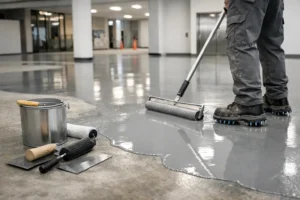
The finish gets the attention, but the preparation does the heavy lifting. Resin flooring is only as good as the surface beneath it. If the concrete is contaminated, weak, cracked or damp, those issues must be dealt with before any coating or screed goes down.
This is why proper assessment matters. Moisture levels, existing damage, substrate strength and previous coatings all affect what can be installed successfully. Mechanical preparation, repairs and priming are not optional extras. They are what allow the resin system to bond correctly and perform as intended.
Cheap fixes often fail because this stage is rushed. A floor might look acceptable on handover, but if the groundwork is poor, peeling, bubbling or premature wear usually follows. For industrial clients, that is not just frustrating – it is costly.
Where industrial resin flooring works best
Industrial resin flooring in Northern Ireland is used across far more settings than many people realise. Manufacturing units, warehouses, loading areas, workshops and garages are obvious examples, but resin systems are also well suited to hospitality back-of-house spaces, healthcare environments, retail stockrooms, laboratories and food preparation areas.
Each setting brings its own priorities. A production floor may need chemical resistance and heavy-duty wear performance. A commercial kitchen may prioritise hygiene and slip resistance. A showroom workshop may need strength, easy cleaning and a finish that looks sharp for customers.
That is why a consultation-led approach makes sense. Flooring should be specified around the building, not forced into a one-size-fits-all package.
Design still matters in industrial spaces
Performance comes first, but appearance still has a role. A well-finished resin floor gives a building a more organised, professional look. Lighter colours can improve brightness, marked walkways can support safety, and branded zones can reinforce presentation in customer-facing environments.
For some clients, that visual uplift is a bonus. For others, it is part of the business case. A clean, high-quality floor helps shape first impressions and shows that the premises are being properly maintained. In competitive sectors, that matters more than people think.
Surface King works with clients who want both sides of the equation – dependable surface performance and a finish that improves the space visually.
What to consider before you choose an installer
Industrial flooring is not the place to buy on price alone. The right contractor should be able to explain which system suits the site, what preparation is required, how long the programme will take and what level of aftercare is sensible.
It is also worth looking at whether the installer understands the wider use of resin systems rather than treating industrial flooring as a sideline. Specialist knowledge makes a difference when the job involves moisture-sensitive substrates, tight turnaround windows, anti-slip requirements or specific durability targets.
A good contractor will also be honest about trade-offs. Some systems offer faster return to service, while others may be better for heavy traffic or budget control. The best advice is rarely about pushing a single product. It is about matching the system to the building and the way it operates.
Long-term value, not just upfront cost
Every flooring project has a budget, but the cheapest quote is rarely the most economical once the building is back in use. Early failure, constant patching, cleaning difficulties and lost operating time all add cost that does not show on the original estimate.
A well-specified resin floor can offer strong long-term value because it is built to last, straightforward to maintain and less likely to let the site down under pressure. When businesses compare options properly, they usually find that performance, lifespan and downtime matter more than the lowest starting price.
That is particularly true in environments where floors are used hard every day. If a surface has to support production, storage, safety and presentation at the same time, investing in the right system pays for itself far more convincingly than a short-term fix ever will.
If your current floor is creating more problems than it solves, it is probably time to look at the space differently. The right resin system does more than cover concrete – it gives the building a stronger, cleaner and more dependable foundation for the work ahead.