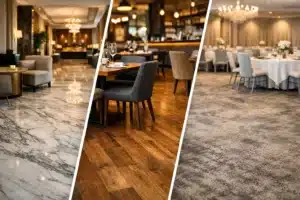
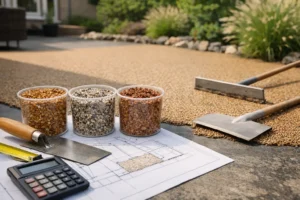
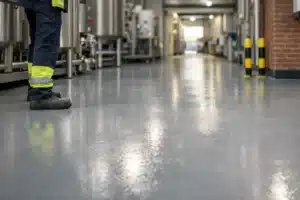
A warehouse floor that powders under forklift traffic, a restaurant kitchen that turns slippery by mid-service, a showroom that always looks tired no matter how often it is cleaned – these are usually surface problems, not cleaning problems. Choosing from the top commercial resin flooring options starts with understanding how the floor needs to perform day after day, not simply which finish looks best in a brochure.
For commercial and industrial spaces, resin flooring is popular for good reason. It can deliver a hard-wearing, easy-to-clean and highly attractive finish, while also addressing practical demands such as chemical resistance, slip reduction, hygiene and fast installation. The right system can transform a space visually and operationally. The wrong one can leave you paying twice.
Top commercial resin flooring options for different sites
There is no single best resin floor for every environment. The best choice depends on traffic levels, cleaning regimes, exposure to chemicals, expected downtime and the standard of finish you want clients, staff or visitors to see.
In most commercial settings, the main systems worth considering are epoxy resin flooring, polyurethane resin flooring, MMA flooring and polyaspartic coatings. Each has strengths, and each suits certain sites better than others.
Epoxy resin flooring
Epoxy remains one of the most widely specified commercial flooring systems because it offers a strong balance of cost, durability and finish. It creates a hard, dense surface that stands up well to foot traffic, wheeled traffic and regular cleaning. It is also available in a wide range of colours and can be installed as a smooth coating, a self-smoothing floor or a heavier-duty screed system depending on the application.
For retail units, stock rooms, plant rooms, workshops and many warehouse areas, epoxy is often the first option considered. It gives a clean, professional look and performs well where the demands are predictable and the substrate is properly prepared.
The trade-off is that epoxy is not ideal for every environment. It can be less tolerant of thermal shock than some alternatives, so spaces with extreme temperature swings or frequent hot washdowns may need something more specialised. Cure times can also be longer, which matters if your business cannot afford extended closure.
Polyurethane resin flooring
Polyurethane flooring is a strong contender where hygiene, heat resistance and durability matter more than a showroom-style decorative finish. It is commonly used in food production, commercial kitchens, pharmaceutical spaces and heavy-duty industrial settings because it copes well with thermal movement and challenging cleaning regimes.
If your floor sees hot water, steam cleaning, spills, impact and constant use, polyurethane often makes more sense than a standard epoxy coating. It is built for tougher service conditions and can deliver excellent long-term value when specified correctly.
That said, polyurethane systems are usually a more specialist installation and can come at a higher upfront cost. For a light-duty office back room or a boutique retail unit, that extra performance may be unnecessary. This is where good advice matters – paying for industrial-grade resistance you will never use is not always the smart choice.
MMA resin flooring
MMA, or methyl methacrylate, is often chosen when time is the deciding factor. Its biggest advantage is speed. In the right conditions, MMA systems can cure far faster than traditional epoxy or polyurethane, allowing businesses to get areas back into service quickly.
That makes it attractive for hospitality, retail refits, healthcare environments and commercial sites where downtime has a direct cost. If a floor needs to be installed or repaired overnight, over a weekend or during a tight shutdown, MMA can be the answer.
Performance-wise, MMA is also durable and versatile, with options for slip resistance and decorative finishes. The key consideration is that it requires experienced handling and installation. It also has a stronger odour during application, so planning around occupied spaces is essential.
Polyaspartic floor coatings
Polyaspartic systems are increasingly specified where clients want a combination of quick return to service, UV stability and a high-quality finish. They can work well in commercial interiors and some mixed-use spaces where appearance matters just as much as toughness.
Compared with some traditional resin systems, polyaspartic coatings can offer faster curing and better resistance to yellowing in areas exposed to sunlight. For entrance areas, showrooms, automotive spaces and some retail environments, that is a real advantage.
Like MMA, though, polyaspartic products need skilled installation and careful preparation. Fast-curing products leave less room for error. They are not a shortcut for poor groundwork.
How to choose between the top commercial resin flooring options
The floor should suit the building, the business and the daily reality of the space. That sounds obvious, but many flooring failures happen because the decision is based on one factor alone, usually price or appearance.
Start with traffic. Light footfall in an office or showroom places very different demands on a floor than pallet trucks, forklifts or heavy manufacturing equipment. Then look at contamination risks. Oils, cleaning chemicals, food waste, water and abrasive debris all affect which system is suitable.
Next, think about safety and compliance. In kitchens, healthcare settings and production areas, slip resistance and hygiene can be just as important as wear resistance. The finish needs to support cleaning, not fight against it. In customer-facing areas, appearance and brand presentation also matter. A resin floor can be functional, but it should still look the part.
Downtime is another major factor. If your site can close for several days, epoxy may be perfectly practical. If you need the area turned around rapidly, MMA or polyaspartic systems may be more suitable. Faster systems often cost more, but lost trading time can cost far more than the flooring itself.
Decorative finish versus industrial performance
Some clients assume commercial resin flooring must look purely utilitarian. That is no longer the case. Modern resin systems can deliver clean, contemporary finishes with strong colour consistency, zoning, line marking and even branded design features where appropriate.
For hospitality venues, salons, showrooms and reception areas, decorative appeal can be part of the brief from the start. In these settings, a resin floor is not only a protective surface. It helps shape first impressions. A smart, polished floor tells customers the business is well run.
In harder-working spaces, performance still comes first, but appearance should not be ignored. Even a warehouse or service corridor benefits from a floor that looks bright, clean and professionally installed. It improves the environment for staff and supports a better standard of maintenance.
The right contractor will help balance both priorities rather than pushing a one-size-fits-all system.
Why preparation matters more than product labels
A high-quality resin product will not compensate for weak preparation. This is one of the biggest differences between a floor that lasts and one that starts failing early.
The condition of the existing substrate has to be assessed properly. Cracks, moisture issues, contamination and uneven sections all need to be identified before installation starts. Surface preparation, repairs, primer choice and system build-up are not minor technicalities. They are what determine adhesion, finish quality and service life.
That is why specialist specification matters. A resin floor is only as good as the groundwork beneath it and the team installing it. For businesses in Belfast and across Northern Ireland looking for a long-lasting result, working with a contractor that understands both product supply and installation makes the process more reliable from day one.
Which resin flooring option is best?
If you want a dependable all-rounder for many commercial spaces, epoxy is often the leading choice. If heat, hygiene and heavy service conditions are central to the environment, polyurethane is usually stronger. If speed is critical, MMA and polyaspartic systems deserve serious consideration.
The real answer, though, is that the best floor is the one specified around your site conditions, usage and finish requirements. A busy kitchen, a warehouse, a clinic and a customer-facing showroom may all need resin flooring, but they rarely need the same resin flooring system.
That is where a consultation-led approach pays off. At Surface King, the focus is on matching the right resin system to the job so clients get a floor that looks sharp, performs properly and lasts.
If your current commercial floor is hard to clean, wearing out too quickly or letting down the space visually, the right resin system can change how the whole site functions. A better surface does more than cover the ground – it gives your business a stronger foundation to work from.