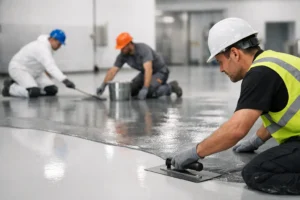
A factory floor that looks fine at 8am can become a liability by 2pm. Forklift traffic, chemical spills, wet cleaning, dropped tools and constant footfall all test a surface far harder than most people expect. That is why an industrial resin flooring guide matters – not as a box-ticking exercise, but as a practical way to choose a floor that performs under pressure, protects your operation and still looks the part.
For industrial and commercial decision-makers, the right resin floor is rarely about one feature alone. Durability matters, but so does cure time. Slip resistance matters, but so does cleanability. Appearance matters too, especially in customer-facing spaces, food environments and facilities where standards are visible from the moment someone walks through the door. A well-specified system should support the way your site actually runs, not force your team to work around flooring problems.
What this industrial resin flooring guide should help you decide
The first question is not which resin is best. It is best for what. A warehouse with heavy vehicle movement has different priorities from a commercial kitchen, workshop, showroom or pharmaceutical area. Some sites need exceptional impact resistance. Others need chemical resistance, hygiene performance or very fast installation to keep downtime to a minimum.
That is where many flooring decisions go wrong. Buyers compare products in isolation instead of comparing them against the demands of the building. Resin flooring is not one single finish. It is a category of systems, each with strengths, limitations and ideal applications.
The most common industrial options are epoxy, polyurethane and fast-curing systems such as MMA and polyaspartic. Each can deliver a high-quality finish, but they are not interchangeable.
Understanding the main resin flooring systems
Epoxy resin flooring
Epoxy remains one of the most widely specified industrial flooring options, and for good reason. It provides a hard-wearing, attractive and easy-to-clean surface that suits many factories, warehouses, retail back-of-house areas and plant rooms. It also offers strong resistance to many chemicals and can be installed in a range of thicknesses depending on the level of use.
Where epoxy performs especially well is in environments that need long-term durability and a tidy, professional finish. It can be laid as a coating, screed or self-smoothing system, which gives flexibility on both budget and performance. For many businesses, epoxy is the practical middle ground between cost, appearance and service life.
Its limitation is cure time. If your operation cannot afford to close areas for long, a standard epoxy system may not be the best fit. It can also become less suitable in areas exposed to thermal shock or significant temperature swings unless the specification is carefully matched.
Polyurethane resin flooring
Polyurethane, often shortened to PU, is a strong choice where heat resistance, chemical resistance and heavy-duty performance are priorities. It is often used in food production, commercial kitchens, engineering environments and processing facilities where floors take more punishment than a standard coating can comfortably handle.
A PU system tends to cope better with thermal movement than epoxy. That makes it useful in spaces with hot washdowns, steam cleaning or temperature variation. It also stands up well to aggressive cleaning regimes, which is critical where hygiene compliance matters.
The trade-off is that polyurethane systems can be more specialised and may carry a higher upfront cost. That said, on the right site, the added performance often makes financial sense over time.
MMA and polyaspartic systems
If downtime is the issue driving the project, MMA and polyaspartic floors deserve close attention. These systems are known for rapid curing, which means areas can often return to service far quicker than with traditional resin options. For busy commercial and industrial premises, that can be the difference between a manageable upgrade and a major operational headache.
Fast-curing systems are particularly useful in retail units, hospitality, healthcare environments and industrial spaces where closure windows are tight. They also work well for phased refurbishments, where keeping parts of a site operational is essential.
The key point is that speed should not be viewed in isolation. Fast return to service is valuable, but only if the system is also suitable for the traffic, cleaning and wear the floor will face every day.
Choosing the right finish for your environment
A strong resin floor is not only about the material. Surface texture, thickness, build-up and preparation all shape the final result. Two floors may both be described as epoxy, yet perform very differently because one is a thin coating and the other is a heavy-duty screed.
Slip resistance is a good example. A smoother floor may be easier to clean, but if the area is regularly wet, greasy or exposed to spillages, extra texture may be necessary. That improves safety, though it can slightly change cleaning requirements. The best outcome usually comes from balancing safety with maintenance rather than chasing one feature to the extreme.
Appearance matters as well. Industrial flooring does not have to look purely functional. Colour zoning, line marking and tailored finishes can improve workflow, reinforce safety and create a cleaner, more professional environment. In customer-facing commercial settings, the visual impact can be just as important as the technical performance.
Why preparation matters more than most buyers realise
The finish is what people see, but the substrate is what determines whether the floor lasts. If the base is weak, contaminated, damp or uneven, even a premium resin system can fail early. That is why proper assessment and preparation are not optional extras. They are central to the job.
Concrete condition, moisture content, existing coatings, cracks and movement all need to be reviewed before the system is specified. Mechanical preparation is typically required to create the right bond. In some cases, repairs or levelling work must be completed first.
This is also where a specialist contractor adds real value. Good flooring is not just supplied. It is matched to the site, installed correctly and supported by practical advice on aftercare and lifespan.
Budget, lifespan and the real cost of getting it wrong
An industrial floor should be judged on whole-life value, not simply on initial price. A cheaper coating that wears prematurely, peels under traffic or causes downtime for repairs quickly becomes expensive. The better question is how long the floor is likely to last in your environment and what level of maintenance it will need.
That does not mean the most expensive system is always the right one. Some sites are being overspecified and paying for performance they do not need. Others are being underspecified and then wondering why the floor struggles within a short period. The strongest buying decisions come from matching the system to the job rather than picking by price alone.
For landlords, facilities managers and industrial operators, reliability has a direct commercial value. A floor that is easy to clean, safe underfoot and built for the actual level of use reduces disruption and supports a better working environment.
An industrial resin flooring guide for practical buying decisions
If you are comparing quotes, ask what resin system is being proposed, what preparation is included and how the floor is expected to perform in your specific setting. Ask about cure times, slip resistance, thickness and suitability for the chemicals, traffic and cleaning methods on site. Those details matter far more than a headline price.
It is also worth asking how the installation will be phased. On live sites, programme planning can be just as important as material selection. A contractor who understands industrial environments will think about access, downtime, safety and continuity from the start.
For businesses across Belfast and Northern Ireland, that local understanding matters. Industrial and commercial flooring projects need practical advice, dependable workmanship and a finish that stands up to real use. A specialist team such as Surface King can help clients weigh up epoxy, MMA, polyurethane and other resin systems with a clear focus on performance, appearance and long-term value.
The best floor is the one that keeps working long after the installation team has left – clean, durable, safe and fit for the pace of your business.